

AQUALABS
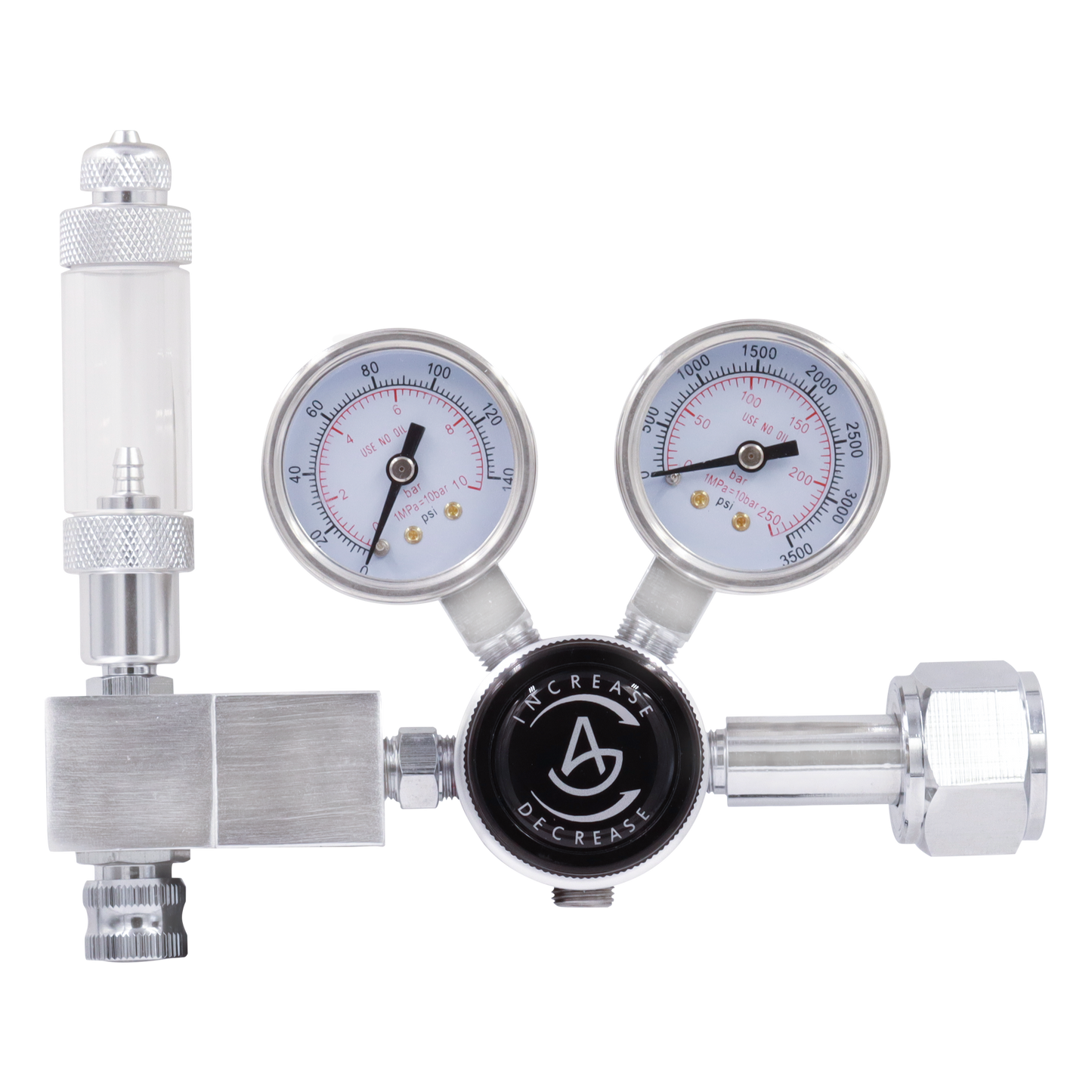
AquaLabs Pro Dual Stage CO2 Regulator
AquaLabs Pro Dual Stage CO2 Regulator
Couldn't load pickup availability
Unmatched precision and stability. The AquaLabs Pro Dual Stage CO2 Regulator is built for the most demanding planted aquariums. Pressure is reduced in two distinct internal stages, which holds your output steady no matter what the cylinder is doing. Paired with a safe, low heat solenoid, injection can be automated on a timer, and optional manifold extensions let one regulator run up to eight aquariums with independent control of each.
Why dual stage matters
CO2 in a cylinder is stored as a liquid. That means head pressure sits at roughly 850 psi and stays there for almost the entire life of the cylinder, right up until the last of the liquid vaporises. Only then does pressure begin to fall.
This is where single stage regulators fail, and the failure is counterintuitive. As inlet pressure falls, a single stage regulator's output pressure rises, because the force balance across its diaphragm shifts. The result is a flood of CO2 into the aquarium at a point nobody is watching for. It is known as end of tank dump, and it is one of the most common ways an otherwise healthy planted tank is lost overnight.
CO2 output across the life of a cylinder. Both regulators behave while liquid remains. Only the dual stage holds its output once the cylinder starts to empty.
How the two designs differ
One thing worth knowing when comparing regulators: dual gauges and dual stage are not the same thing. A number of regulators sold as dual stage simply carry two gauges on a single stage body. The gauges tell you cylinder and working pressure. The stages are internal and are what actually protect your fish. The AquaLabs Pro has both.
Stable CO2 is not only a livestock issue. Fluctuating CO2 is the leading cause of black beard algae in injected aquariums, so a regulator that holds its output is doing two jobs at once.
Key features
- True dual stage construction for ultimate output stability
- Safe, low heat solenoid for timer automation
- Dual gauges for cylinder and working pressure
- Adjustable working pressure, suits any diffuser or inline atomiser
- Super precise brass needle valve
- Bubble counter with built in check valve
- Optional manifold extension, expandable to 8 outlets
- Compatible with Australian CO2 cylinders
Solenoid
- 12V DC solenoid, 3.0W
Warranty
- 5 years
Which regulator do I need?
Both are true dual stage. The difference is how many aquariums you are running and how much control you want over them.
Singletank Mini Dual StageCompact and beginner friendly, with a 360° rotatable needle valve for vertical or horizontal cylinders. One aquarium. Multi
tank Pro Dual Stage You are hereDual gauges, manifold expandable to 8 independently controlled outlets. For serious single tanks and multi tank setups.
CO2 is a compressed gas. Always fit the regulator to a cylinder within its test date, tighten the regulator to the cylinder with the provided spanner and check for leaks with a soapy water spray.
Always run a check valve between the regulator and the aquarium. Without one, water can siphon back into the regulator and ruin it. A check valve is built into the supplied bubble counter.
Close the cylinder valve before disconnecting. Never dismantle a regulator while it is under pressure.
Installation video
Removal video
FAQ
What is end of tank dump and will this prevent it?
End of tank dump is a sudden surge of CO2 that occurs as a cylinder empties. Because CO2 is stored as a liquid, cylinder pressure holds steady until the last of the liquid vaporises, then falls away. In a single stage regulator, that falling inlet pressure causes output pressure to rise, flooding the aquarium.
Dual stage construction is the accepted solution. The first stage drops to a fixed intermediate pressure, so the second stage sees a near constant inlet and holds its output regardless of what the cylinder is doing.
What working pressure should I set?
Around 30 psi works for most diffusers. Our Micro Mist diffuser is the exception, since its high pressure membrane needs 45 psi to produce the ultra fine mist it is designed for. Inline atomisers generally sit in the same higher range.
Set the working pressure first, then use the needle valve for fine bubble rate control. Adjusting bubble rate by changing working pressure rather than the needle valve is a common mistake and makes the system harder to hold steady.
Will it fit Australian CO2 cylinders?
Yes. The Pro Dual Stage is built for the cylinder fitting used in Australia, so it will connect to cylinders from Australian gas suppliers without an adapter.
How many aquariums can one regulator run?
Up to eight, using optional manifold extensions. Each outlet has its own needle valve, so every aquarium can be set to its own bubble rate from the one cylinder and one solenoid.
This is the main practical difference between the Pro and the Mini. If you are running a single aquarium and expect to keep it that way, the Mini covers you.
Can I run the solenoid on a timer?
Yes, and you should. Start injection 90 minutes to 2 hours before your lights come on, so the aquarium has reached its target CO2 concentration by the time the plants need it. Shut it off an hour or so before lights out.
Running CO2 through the night achieves nothing, since plants do not photosynthesise in the dark, and it drops pH overnight for no benefit.
Do I still need a check valve?
A check valve is built into the supplied bubble counter. Many aquarists fit a second one closer to the aquarium as cheap insurance, since a failed check valve means water siphoning back into the regulator.
How do I know when the cylinder needs refilling?
The cylinder gauge will read close to full for almost the entire life of the cylinder, because liquid CO2 maintains its own head pressure. Once that needle starts to fall, the remaining gas will go faster than you expect, though how much faster depends entirely on your bubble rate and tank size.
The practical approach is to keep a spare full cylinder rather than relying on the gauge for warning. A dual stage regulator protects your livestock through that drop, but your plants still lose their carbon supply.
Installation Video
Removal Video